(A story of forgiveness, distance, and rediscovery)
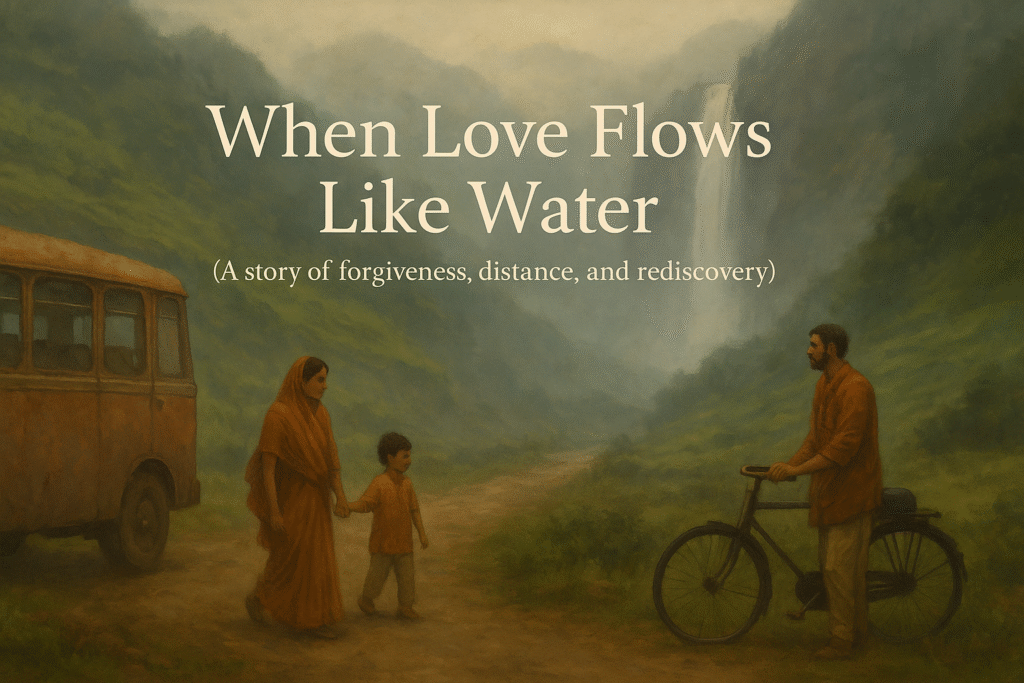
The bus slowed to a halt on a misty hill road, breathing out a cloud of dust and weary passengers. A woman stepped down, her little boy clutching her hand. An older man followed, humming softly.
Waiting nearby stood another man beside a small cycle loaded with luggage, eyes uncertain yet hopeful. He had come to pick them up.
The morning air was cool, filled with the scent of rain and soil. No words passed between him and the woman — only the faint echo of something old and unfinished, like the last note of a song that once meant everything.
The boy laughed, his voice bright as the sun filtering through clouds. The man smiled faintly, tightening the strap of the bag on the cycle. Their eyes met once — a silent acknowledgement, neither greeting nor farewell.
They began walking along the hilly road, the boy skipping ahead, the uncle trailing behind. The small cycle squeaked with every turn of its wheel, carrying their shared weight — not just of luggage, but of memory.
After a while, they grew tired and stopped near a field. The woman sat on a rock, brushing dust from her saree. The man stood a few steps away, pretending to adjust the cycle. The uncle wandered off toward the bushes. The boy played with pebbles by the roadside.
A stranger appeared, carrying a metal can of water. “Take a drop,” he said kindly, setting it down on the cycle. “The road ahead climbs higher.”
The man looked at her, unsure. She met his gaze briefly — steady, unreadable — then looked away. He took the can, drank a little, and placed it back. For a moment, her eyes softened, as though she’d remembered another time when such simple kindness once meant love.
They walked on. The hills grew steeper, and soon the sound of rushing water reached their ears. Around a bend, a great waterfall revealed itself — cascading silver under the afternoon light, roaring like a memory set free.
The boy ran forward, laughing again, his joy echoing off the stones. The man watched him, then lifted the half-filled can and poured it out at the waterfall’s edge.
“Some things,” he whispered, “must be emptied before they can be filled again.”
She heard him. When she looked back, he was standing beneath the mist, eyes closed, water running down his face — as though the mountain itself was washing his silence clean.
She smiled faintly, almost involuntarily. The boy tugged at her hand, and she followed him across the rocks. A kind traveller offered help; she accepted with a nod.
When she turned again, the man was watching her — not with longing, but with peace. The distance between them no longer hurt; it simply existed, like the space between two waves of the same ocean.
They reached the path leading to the village below. The boy walked between them, holding one hand in each. Neither spoke. Neither let go.
And behind them, the waterfall kept singing — not of loss, but of release.
“Love doesn’t always return as fire — sometimes it comes back as rain, quiet and cleansing, ready to begin again.”